A New Dawn in the World of Artificial Intelligence
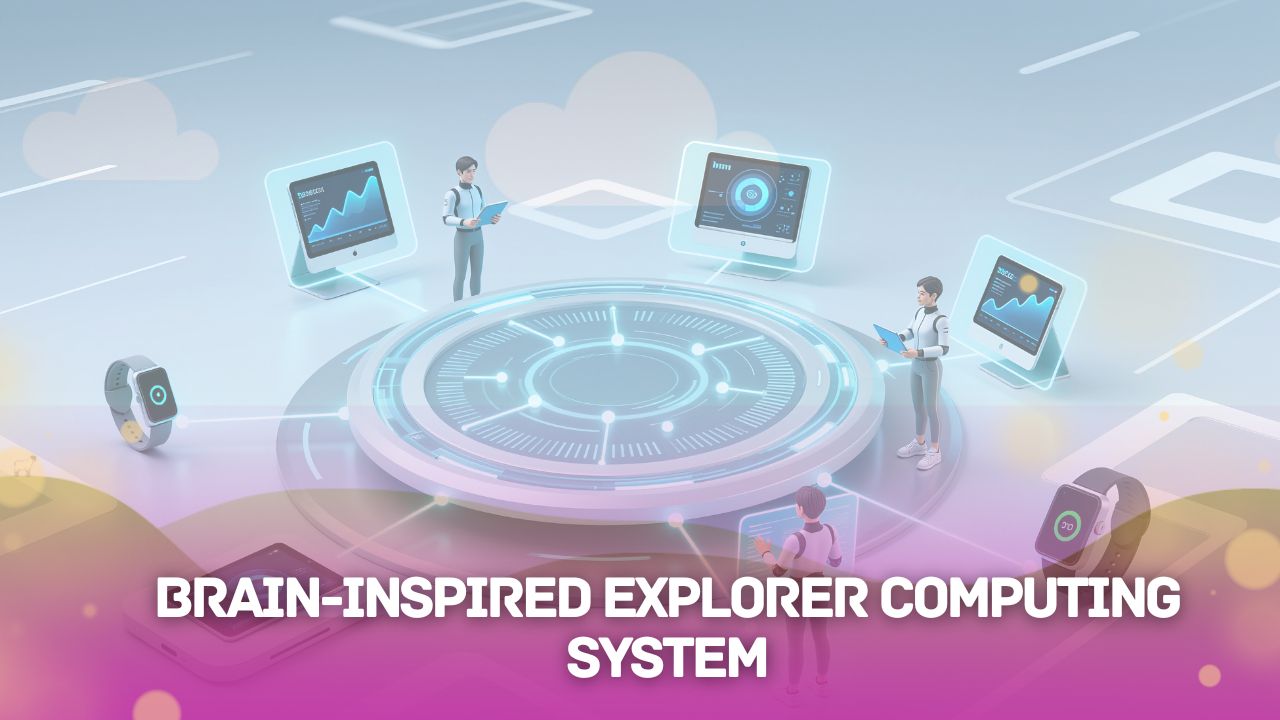
Artificial Intelligence (AI) has quietly become a vital part of our daily lives — from homes and offices to massive data centers powering the digital world.
But behind this technological revolution lies a serious challenge: energy consumption.
Supercomputers running advanced AI models consume enormous amounts of electricity. They fill entire rooms, generate extreme heat, and leave a large carbon footprint. This has raised global concerns about sustainability.
Now, Chinese scientists have unveiled an invention that could redefine AI computing — a compact yet ultra-efficient system called BIE-1 (Brain-Inspired Explorer Computing System).
⚙️ What is BIE-1? A Supercomputer in the Size of a Mini Fridge
Developed by the Guangdong Institute of Intelligence Science and Technology (GIIST), BIE-1 is no bigger than a small refrigerator — around 50 cm tall and 40 cm wide — but packs the power of a full supercomputer.
It contains 1,152 CPU cores, 4.8 TB of DDR5 memory, and 204 TB of storage, yet consumes 90% less electricity than traditional systems.
If an old system uses 10 units of power, BIE-1 only needs one.
Even more impressive, it operates at just 45 decibels (quieter than normal conversation) and stays below 70°C without any special cooling. You can literally plug it into a home socket and run complex AI workloads.
💬 As one scientist put it:
“We’ve compressed the power of a supercomputer into something the size of a refrigerator.”
🧠 Brain-Inspired Intelligence – How It Works
Traditional computers rely on logic and arithmetic — they process data linearly like calculators.
BIE-1, however, mimics the human brain through what scientists call an Intellectual Neural Network (INN).
It learns from smaller datasets, remembers old information while learning new, and can process text, images, and sound simultaneously.
This makes it energy-efficient, adaptive, and explainable — it doesn’t just give answers but can explain how it reached them.
Just as the human brain performs complex tasks using only about 20 watts of energy, BIE-1 uses similar “neuromorphic” principles to achieve massive computing power with minimal electricity.
🧩 The Institution Behind It: GIIST – China’s Center for AI Innovation
Located in Hengqin, Zhuhai (Guangdong Province), the Guangdong Institute of Intelligence Science and Technology was established in 2021.
Its mission: build brain-like computing systems that can learn, adapt, and reason like humans.
Directed by Professor Zhang Shu, a senior member of the Chinese Academy of Sciences, GIIST collaborates with Zhuhai Hengqin New Gene Intelligent Technology and Suiran (Zhuhai) Medical Technology — both partners in creating BIE-1.
At its unveiling during the Guangdong-Macao Forum in 2025, the project was hailed as a milestone in China’s quest for sustainable, intelligent computing.
🌍 Why It Matters: The Energy Crisis of AI
AI’s global power demand is skyrocketing. Experts predict that by 2030, AI data centers could consume 20% of the world’s electricity — up from 8% in 2025.
Companies like Google and Microsoft already spend billions on power and cooling their AI servers.
China, too, has invested $37 billion in converting farmlands into data centers — a move criticized for environmental damage.
BIE-1 offers a sustainable alternative.
It uses far less electricity, occupies minimal space, and can bring high-end AI computing within reach of homes, schools, hospitals, and small businesses.
💡 Potential Applications – From Homes to Hospitals
- 🏠 Smart Homes: Personal AI assistants that monitor health, remind medication, and teach children interactively.
- 🏢 Offices: Small businesses using AI customer support or analytics without expensive cloud infrastructure.
- 🚑 Healthcare: Real-time disease diagnostics, image recognition, and patient monitoring.
- 🎓 Education: AI tutors for rural areas, adapting lessons to each child’s pace.
- 🛰️ Defense & Mobile Units: On-field AI analysis for doctors, engineers, and military operations.
By democratizing AI access, BIE-1 could transform every industry — making intelligence “green, fast, and understandable.”
🇨🇳 China’s AI Ambition & Global Competition
China aims to lead the world in AI by 2030, integrating brain-like computing into its economy.
It already owns some of the world’s fastest supercomputers, like Sunway TaihuLight, and is advancing in neuromorphic chips and AI sustainability.
While the U.S. and Europe have competing systems like Hala Point, BIE-1 stands out for its compact size, low energy use, and practical deployment.
🔮 Challenges & The Road Ahead
Like any breakthrough, BIE-1 faces challenges:
- Security and data protection from hacking.
- Cost optimization for mass adoption.
- Continuous testing for stability and precision.
However, if scaled successfully, this could mark the start of a new era of sustainable AI — where machines think like humans but respect the planet’s limits.
By 2030, global AI power demand may hit 1,000 terawatt-hours, but innovations like BIE-1 could turn the tide — proving that intelligence doesn’t have to come at the cost of energy or environment. 🌏⚡