Make-or-Break in Islamabad: The Historic US-Iran Talks That Could End a Six-Week War
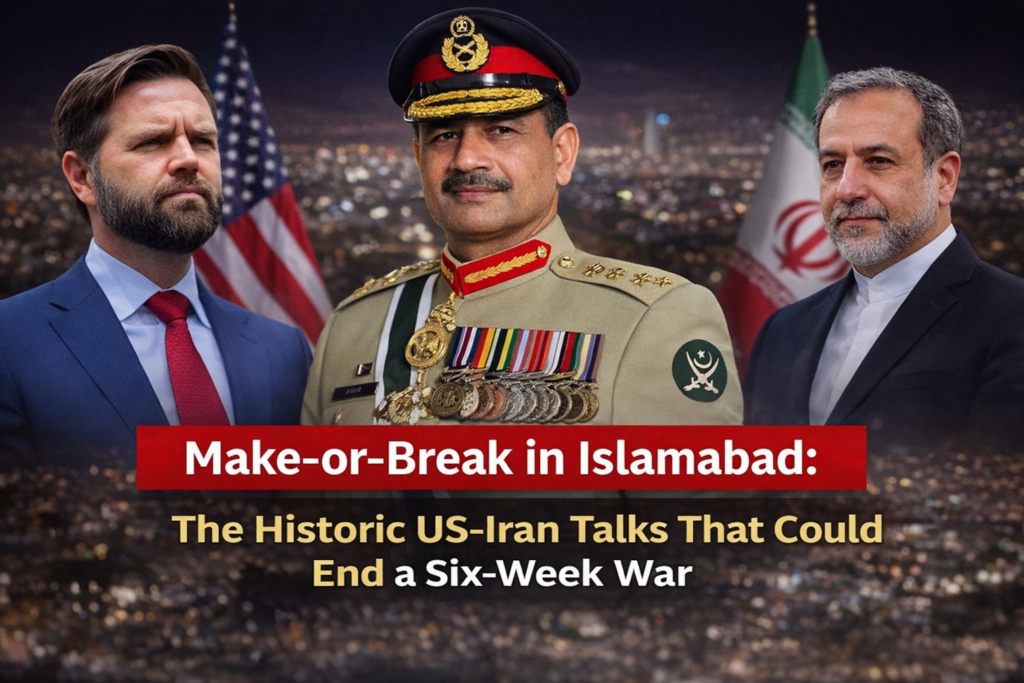
With VP JD Vance leading the American team and Iran’s parliament speaker heading Tehran’s delegation, Pakistan is hosting the highest-level US-Iran engagement since 1979 — but deep divisions over Lebanon, nuclear enrichment, and the Strait of Hormuz threaten to derail the fragile ceasefire before talks even begin.
Analysis DeskApril 11, 2026 Islamabad, Pakistan
6 weeks
Since war began
5,600+
Killed in conflict
20%
World oil via Hormuz
2 wks
Ceasefire window
How We Got Here: A War That Shocked the World
On February 28, 2026, the United States and Israel launched coordinated large-scale strikes on Iran, killing Supreme Leader Ayatollah Ali Khamenei and igniting a conflict that has since claimed over 5,600 lives across multiple countries. Iran retaliated by blockading the Strait of Hormuz — the world’s most critical oil chokepoint — sending global energy prices soaring and triggering the worst inflation spike in the United States in four years.
After six weeks of intense hostilities, a Pakistani-brokered two-week ceasefire was announced on April 7, 2026, following a dramatic ultimatum by President Donald Trump. The ceasefire created the narrow diplomatic window now being used for Saturday’s Islamabad negotiations — the highest-level direct engagement between Washington and Tehran since the 1979 Islamic Revolution.
“This is a make-or-break moment. I ask all of you to pray that these talks are successful and countless lives are saved.”— Pakistani Prime Minister Shehbaz Sharif, national address, April 10, 2026
Who’s at the Table: The Delegations
🇺🇸 United States
- JD VanceVice President (delegation head)
- Steve WitkoffSpecial Envoy
- Jared KushnerPresidential Adviser
🇮🇷 Iran
- Mohammad Bagher GhalibafParliament Speaker (delegation head)
- Abbas AraghchiForeign Minister
- Ali Akbar AhmadianSNSC Secretary
Pakistan’s Foreign Minister Ishaq Dar is facilitating the talks in his country’s role as mediator. Notably, Israel — a co-party to the conflict — is not represented, as Pakistan does not recognise Israeli sovereignty. Saudi Arabia, Turkey, and Egypt, while involved in pre-negotiation diplomacy, also hold no formal seat at the table.
Why Vance? Iran’s Preference and the Anti-War Wing
The last-minute elevation of Vice President Vance to lead the US delegation is being read by analysts as a significant signal. Iran reportedly expressed a preference for dealing with Vance over special envoys Steve Witkoff and Jared Kushner. As a former US Marine and a leading voice of the anti-interventionist “Make America Great Again” movement, Vance has consistently been the Trump administration’s most reluctant defender of the Iran conflict.
Analysts at the Foundation for Defense of Democracies note that Tehran likely views Vance’s well-known scepticism of foreign intervention as a more favourable starting position. “I think they probably prefer him knowing that his perspective on foreign intervention is one of skepticism,” said Jonathan Schanzer. Trump himself described his VP as “less enthusiastic” about the war than other senior officials — which may be precisely why Iranians agreed to come to the table at all.
The Format: Proximity Talks at the Serena Hotel
Both delegations flew into Nur Khan Airbase outside Islamabad and were transferred to the city’s Serena Hotel, which was cleared of regular guests for the occasion. Crucially, the negotiations are structured as proximity talks: the two sides will remain in separate rooms, with Pakistani officials acting as shuttles between them — at least initially. According to CNN, the format is expected to evolve into face-to-face discussion once an agenda is agreed through Pakistani mediators.
Pakistan’s experience with proximity diplomacy is not new. In 1988, Islamabad itself participated in the Geneva Accords on the Soviet withdrawal from Afghanistan, where UN-mediated indirect talks produced a landmark agreement. Officials are drawing on that precedent now.
What’s on the Agenda: Five Core Issues
Nuclear enrichment
The US demands Iran halt all uranium enrichment. Iran insists enrichment rights are non-negotiable — a “red line” from both sides.
Strait of Hormuz
Iran must reopen the strait to restore global oil flow. Over 230 tankers are currently waiting to transit; almost none have passed since the ceasefire.
Lebanon ceasefire
Iran demands an end to Israeli strikes on Lebanon as a precondition. The US and Israel maintain Lebanon is not covered by the current truce.
Sanctions relief
The US has signalled willingness to ease sanctions and release frozen Iranian assets, but only in exchange for concrete Iranian concessions.
Regional proxies
Washington wants Iran to cease funding armed groups across the Middle East. Iran sees its regional allies as sovereign actors and a security buffer.
The Key Obstacles That Could Derail the Talks
Lebanon — the Central Faultline
Iran’s parliament speaker said talks are contingent on a ceasefire in Lebanon, where Israeli strikes have killed over 1,888 people. Israel rejects this condition, and Trump has publicly stated Lebanon is outside the ceasefire’s terms. Analysts call this the most likely “breaking point.”
Nuclear enrichment standoff
Iran’s chief nuclear official has called enrichment rights “necessary” for any deal. Karoline Leavitt, the White House press secretary, called zero enrichment “a red line the President is not going to back away from.”
Strait of Hormuz still blocked
Despite the ceasefire terms including the “complete, immediate and safe opening” of the Strait, virtually no ships have passed. Trump accused Iran of “doing a very poor job” and warned that Tehran cannot charge ships a fee to cross it.
Deep mistrust on both sides
“Lack of trust is the biggest obstacle,” said Sahar Khan, a Washington-based analyst. “Both Washington and Tehran are trying to demonstrate that they ‘won’ by making maximalist demands.”
Pakistan’s Moment on the World Stage
For Islamabad, hosting these talks represents its most consequential diplomatic moment in decades. Prime Minister Shehbaz Sharif has invested significant political capital in the mediation, personally brokering the ceasefire framework and mobilising the Pakistani military — including Pakistan Air Force fighter escorts for the Iranian delegation’s flight to Islamabad. Field Marshal Asim Munir, Pakistan’s army chief and a close ally of Trump, is credited as a key backchannel figure in persuading Washington to engage.
“Ceasefires are iterative and the first goal is to build trust. If the US can tame Israel and get it to stop attacking Lebanon during these talks, that’ll be significant.”— Sahar Khan, Institute for Global Affairs, to Al Jazeera
What a Realistic Outcome Looks Like
Pakistan has set itself a deliberately modest goal: not a final peace settlement, but enough common ground to keep the negotiating process alive. Officials describe a successful outcome as both sides agreeing to continue talks — an extension of the ceasefire window and a framework for Phase 2 discussions lasting up to 45 days. Analysts broadly agree that a comprehensive agreement is unlikely in this round, given the scale of mistrust and the number of unresolved issues.
The wildcard, as analysts note, is Trump himself. Iran expert Trita Parsi observed that “Trump’s failed use of force has blunted the credibility of American military threats,” shifting the terrain. And as US economic pressure mounts — with inflation at a four-year high — Trump has strong domestic incentives to declare a deal, however imperfect. Whether he can deliver Israel’s compliance on Lebanon may ultimately determine whether Saturday’s talks succeed or the war resumes.
What Happens If the Talks Fail
The stakes could not be higher. President Trump has already threatened to “wipe out” Iran’s civilisation if a deal is not reached, and has ordered US warships to position for potential strikes. Iran, for its part, has warned that if hostilities resume, it will “set US interests in the region and the Israeli regime on fire.” With 230+ oil tankers stranded outside the Strait of Hormuz and global energy markets on edge, a collapse of the Islamabad process would carry immediate and severe economic consequences for the world — not just the parties to the conflict.